
Accelerate Threat Research and Investigation
Cross-reference reporting faster, spot trends across grouped topics, save important findings, and move through related intelligence without losing context.
Overview
Threat research and investigation often slow down for a simple reason: too much time is spent moving between disconnected sources, tabs, notes, and search queries just to assemble basic context.
Analysts already know how to investigate. The friction comes from the mechanics. Finding the right report, checking whether a behaviour has shown up elsewhere, comparing related writeups, keeping track of useful findings, and spotting broader patterns across many posts all take time when public reporting is scattered and unstructured.
Obstracts helps reduce that overhead. It brings reporting into one place, structures the intelligence inside each post, and gives analysts faster ways to cross-reference, search, group, and return to what matters.
The result is not just faster reading. It is a more efficient research workflow.
What this solves
Research and investigation workflows usually break down in familiar ways:
- Analysts need to cross-reference entities, techniques, malware, or actors across many reports.
- Similar activity may be described in multiple places, but the links are hard to identify quickly.
- Useful posts get lost because there is no clean way to save and revisit them.
- Trend analysis requires repeated manual review of large volumes of reporting.
- Valuable context is available, but it takes too long to collect and compare.
Obstracts addresses these problems by making reporting easier to search, easier to connect, and easier to reuse during ongoing work.
Cross-reference faster
A large part of threat research is cross-referencing.
An analyst may start with one report, one malware family, one ATT&CK technique, one domain, or one threat actor. Very quickly the question becomes: where else does this show up, and what is related to it?
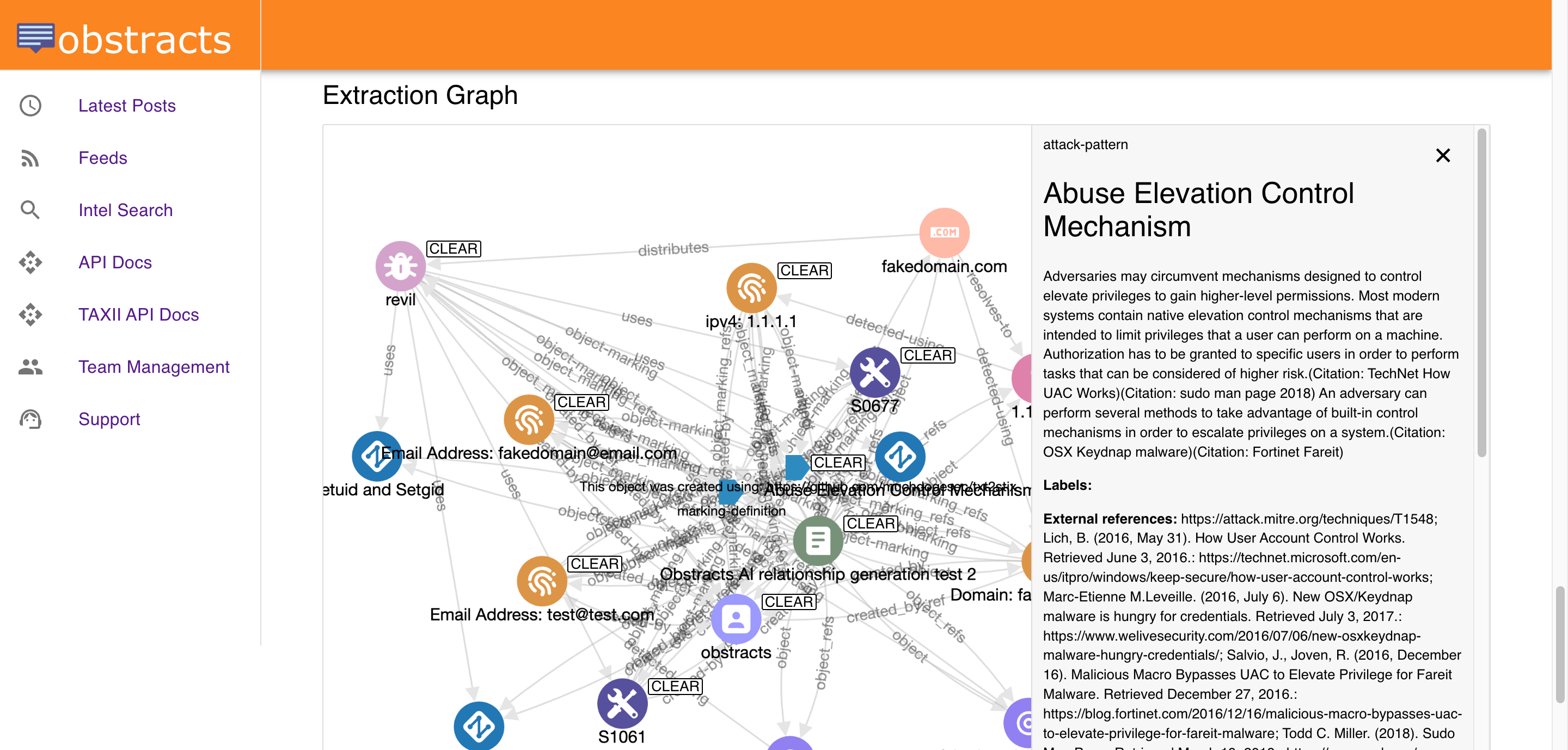
Without structure, that means searching manually across many websites, repeating the same lookups, and trying to remember which reports were already reviewed. With Obstracts, analysts can work from extracted data and connected reporting instead.
This helps teams:
- Search for specific IoCs, TTPs, malware families, or other extracted objects.
- Pivot from one report into others that reference the same or similar activity.
- Compare how multiple publishers describe the same behaviour.
- Build context around a case without leaving the platform repeatedly.
- Reduce the time spent doing repetitive source-by-source searches.
This is especially useful when the goal is not just to confirm a single detail, but to understand the wider picture around a campaign, intrusion set, or behaviour pattern.
Search for trends across reporting
Threat research is not only about individual reports. It is also about patterns.
Analysts often want to know whether a behaviour is becoming more common, whether a malware family is appearing across more sources, or whether several posts are beginning to cluster around the same topic. These trends are hard to spot when reporting is reviewed one page at a time.
Obstracts helps by making it easier to search across many posts and identify trends in the underlying intelligence. This includes the ability to work with grouped topics so related posts can be reviewed together rather than discovered one by one.
That is useful for several kinds of analysis:
- Spotting recurring techniques across recent reporting
- Tracking how interest around a malware family or intrusion set is evolving
- Reviewing grouped posts that point to the same emerging topic
- Identifying repeated infrastructure or behaviour across separate writeups
- Understanding which themes are becoming more prominent over time
Topic grouping is particularly valuable because it helps analysts move from isolated documents to broader patterns. Instead of asking whether one report is interesting, they can ask whether a cluster of reporting signals something larger that deserves attention.
Those same grouped topics are also useful for ongoing monitoring, because they help teams spot emerging themes across trusted sources instead of only reviewing posts one by one.
Move through similar posts more efficiently
One of the biggest time sinks in research is discovering related material too late.
An analyst reads a report, extracts a few useful points, and only later finds out that several similar posts were published elsewhere with overlapping details. That delay makes research slower and increases the risk that key context is missed.
Obstracts helps reduce that problem by making it easier to see similar posts and move through related reporting while the investigation is still in progress.
This improves workflow in a few important ways:
- Similar reporting can be reviewed while the original context is still fresh.
- Analysts can compare overlap and differences between posts more quickly.
- Repeated patterns become easier to spot across sources.
- Investigations are less likely to depend on a single report when multiple relevant sources exist.
For research-heavy teams, this matters because useful context is often distributed. A faster path to similar posts means a faster path to a more complete assessment.
Keep track of important findings with bookmarks
Research work is rarely linear. Analysts often move between several threads at once, pause and return to a case later, or save material for deeper review by another teammate.
That makes simple workflow features surprisingly important. If useful pages cannot be saved and revisited easily, time gets wasted rediscovering the same material.
Bookmarks help solve that.
In the context of Obstracts, bookmarks are useful because they give analysts a straightforward way to preserve important reports, references, or investigation starting points without relying on external note-taking or browser sprawl.
That supports practical day-to-day work:
- Save high-value posts for later analysis.
- Keep track of reports relevant to an active investigation.
- Build a shortlist of sources worth reviewing with a teammate.
- Return quickly to important context without rerunning searches.
- Maintain continuity across multi-day research efforts.
This may seem simple, but it makes a real difference in longer investigations where context accumulates over time.
Support better investigations, not just faster searches
Speed matters, but the goal is not to help analysts click through more content. The goal is to help them investigate more effectively.
Obstracts supports that by combining searchable reporting, extracted intelligence, trend discovery, similar-post navigation, and saved context in one workflow. Each of these capabilities is helpful on its own. Together, they reduce friction across the full research process.
That means analysts can:
- Move from an initial lead to related reporting more quickly.
- Cross-check findings against other sources while investigating.
- Identify broader trends instead of focusing only on single documents.
- Save and return to key material without losing momentum.
- Build a clearer picture from a large body of public reporting.
This is especially valuable when working under time pressure. During active investigations, speed of context-building can be the difference between a shallow read and a useful assessment.
Where this fits in analyst workflows
This workflow is useful anywhere teams rely on public reporting to support research, hunting, triage, or deeper intelligence analysis.
For CTI teams, it reduces the time needed to assemble context across many sources. For SOC analysts, it provides a faster route from an alert or suspicious artefact to related public intelligence. For threat hunters, it makes it easier to connect one observed behaviour to a wider pattern. For investigation teams, it supports more efficient movement between reports, related objects, grouped topics, and saved references.
It is also a strong fit for teams that already know which sources they trust but need a better working layer on top of them. Obstracts helps turn those sources into a searchable research environment instead of a long list of sites to revisit manually.
Why this approach is effective
The value comes from reducing several small but persistent inefficiencies that add up across every investigation:
- Faster cross-referencing across structured intelligence and reporting
- Trend discovery through search and grouped topics
- Easier movement through similar posts
- Bookmarking to preserve context and continuity
None of these on their own replaces analyst skill. What they do is remove unnecessary friction from the workflow so that analyst time goes into interpretation, comparison, and decision-making instead of repetitive retrieval work.
Research with more context, less overhead
If your team depends on public reporting for research and investigation, the challenge is rarely a lack of material. The challenge is working through that material quickly enough and thoroughly enough to extract what matters.
Obstracts helps by making it easier to cross-reference reports, search for trends, review grouped topics, bookmark important pages, and move through similar posts without losing context.
That gives analysts a better way to work: less time juggling sources, less time repeating searches, and more time building useful conclusions from connected intelligence.