
Scale Security Workflows with AI-Ready Threat Intelligence
Support integrations, automation, and AI agents with structured public intelligence instead of raw reporting.
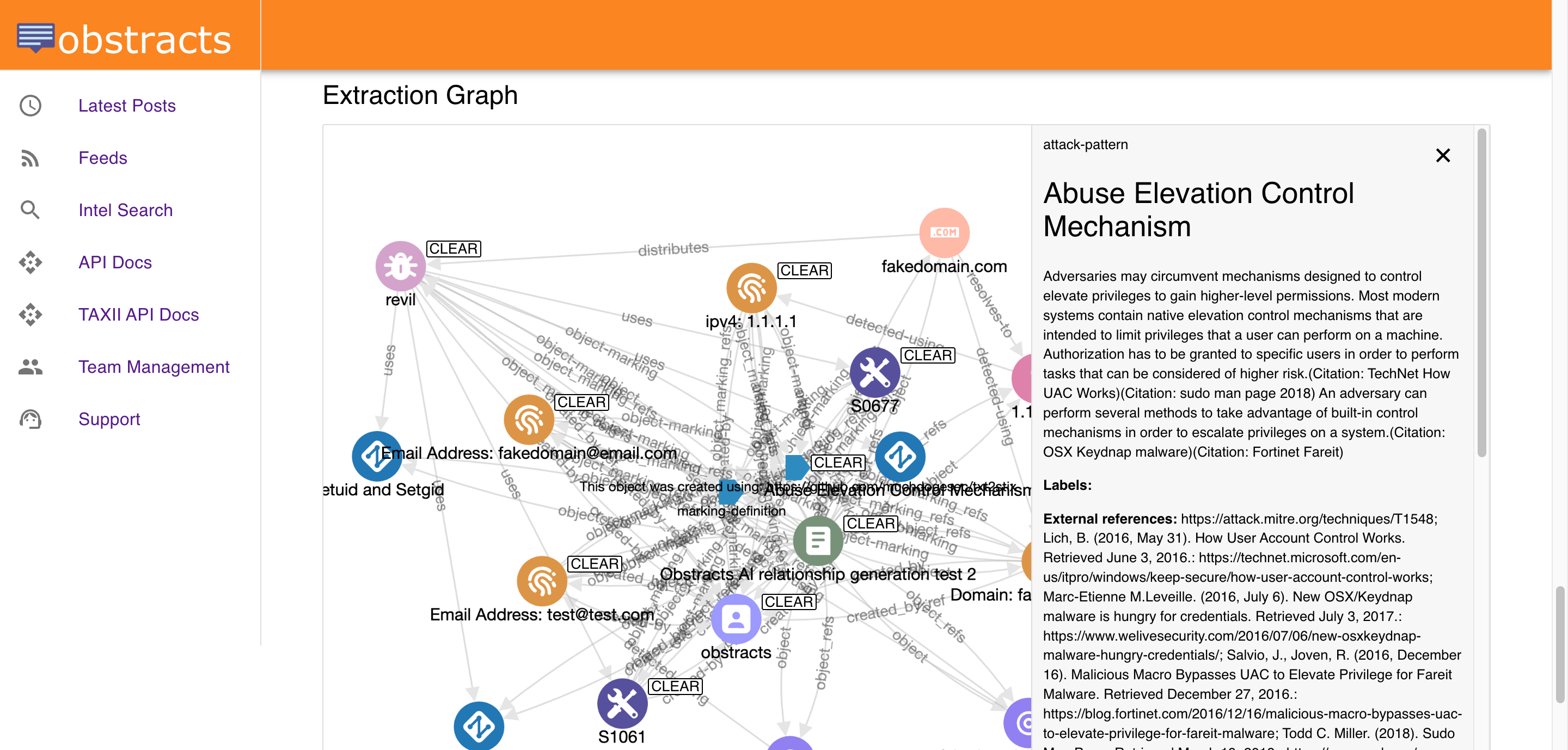
Overview
Automation works better when the underlying intelligence is structured, connected, and easy to move between systems.
That is increasingly important for security teams building integrations, internal tooling, and AI-assisted workflows. Raw reporting may be useful to read, but it is a poor interface for automation. Structured public intelligence is much easier to enrich, correlate, distribute, and reuse.
Obstracts helps make that possible through its API and TAXII-driven workflow support, giving teams a practical way to move public intelligence into existing systems, custom services, and agent workflows.
What this outcome looks like
Scaling security workflows with AI-ready threat intelligence means:
- building custom integrations around structured public CTI
- feeding intelligence into existing platforms and automations
- supporting AI agents with cleaner, more reliable inputs
- reducing manual handoffs between research and action
- making external intelligence available at the point where work happens
This helps teams use automation to amplify analyst work rather than create another layer of disconnected tooling.
Why this matters
Many teams now have automation, SOAR workflows, internal services, or AI agents in place. The limiting factor is often the quality of the input data.
If public reporting remains unstructured:
- integrations are harder to build
- AI outputs are harder to validate
- downstream workflows receive weaker context
- more analyst time is spent translating information by hand
Structured public intelligence improves that foundation.
Where Obstracts fits
Obstracts helps teams move from browser-bound reporting to working system inputs.
That supports:
- custom tooling
- TIP and CTI integrations
- internal enrichment workflows
- downstream detection and response support
- AI-agent and copilot-style use cases
It is a strong fit for organisations that want external intelligence to work inside their stack rather than beside it.
What makes this a solution, not just a feature
The outcome comes from combining:
- structured extraction
- portable data
- standards-friendly sharing
- programmatic access for integrations and workflows
Together, these make public intelligence more usable by software, automations, and agents as well as by humans.